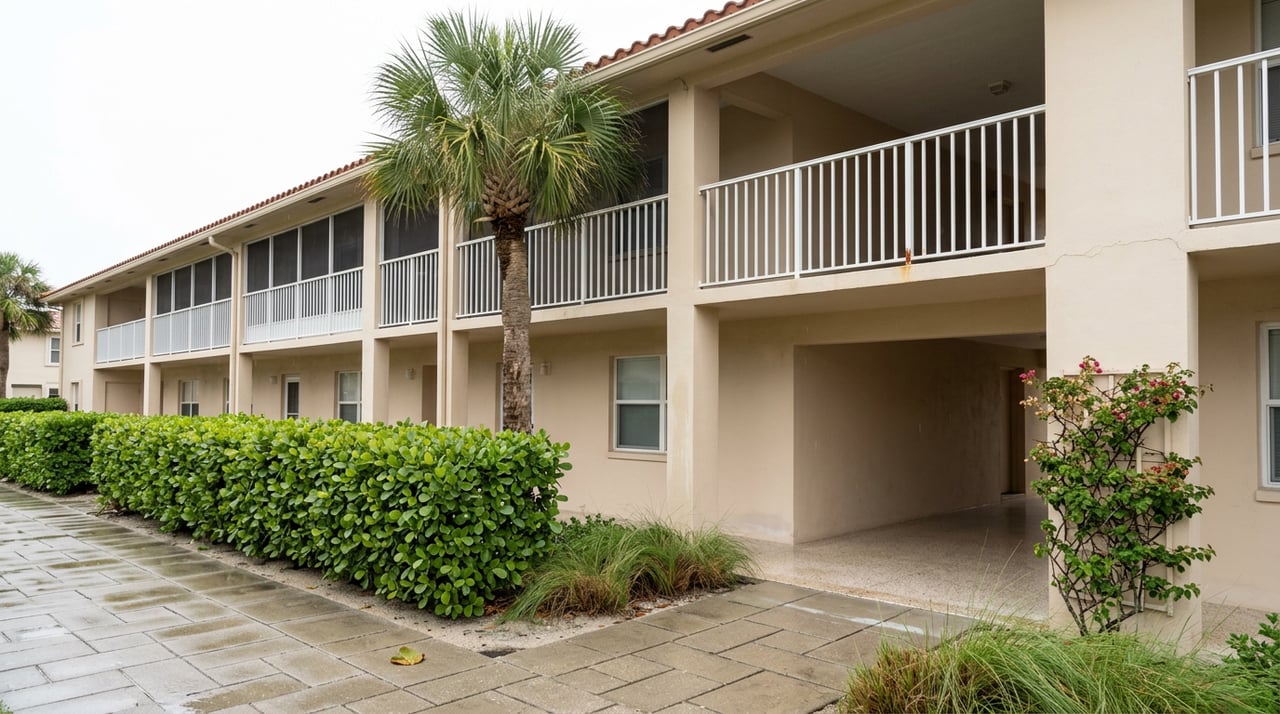
The Cape Canaveral Condo Question That Matters More Than the View
August 20, 2026
August 20, 2026
Two 2-bedroom condos, both a few blocks from the sand, both hovering in the low $300,000s. One has an updated kitchen and a $545 monthly HOA fee. The other has original cabinets and a fee near $991 a month. Most buyers touring both would assume the first one is the better deal. Ask each association about its reserve account, and the answer can flip that assumption completely.
That gap is showing up across Cape Canaveral condo listings this year, sometimes spelled out in the listing remarks, more often buried in documents nobody asks for until after they have already fallen for a balcony view. Florida's post-Surfside inspection and reserve laws are now far enough along that the difference between a fully funded association and one still catching up no longer shows up in price per square foot. It shows up months after closing, in a letter with four figures on it.
After Champlain Towers South collapsed in Surfside in June 2021, Florida's Legislature passed Senate Bill 4-D, later refined by HB 913 and HB 1021. Together they created two separate but related requirements for any condominium or cooperative building three or more habitable stories tall: a milestone structural inspection once the building reaches 25 or 30 years of age, and a Structural Integrity Reserve Study, or SIRS, that maps out how the association funds the roof, load-bearing structure, waterproofing, electrical, plumbing, fire protection, windows and doors it's responsible for maintaining, according to the Florida Department of Business and Professional Regulation.
The milestone inspection age trigger has some nuance worth knowing before you get attached to a specific building. The original law set a 25-year threshold for buildings within three miles of the coast, which covers essentially all of Cape Canaveral. A 2024 change means that earlier trigger is no longer automatic statewide. Local building officials now decide whether their jurisdiction keeps the 25-year rule or defaults to 30, according to M2E Consulting Engineers. If you're comparing two coastal buildings of similar age, it's worth a call to the city building department to confirm which clock is actually running on each one.
Florida law no longer lets associations waive or underfund SIRS reserves for budgets adopted on or after January 1, 2025, and full reserve funding must begin with the budget cycle starting January 1, 2026. Full funding is now the rule, not a vote.
That single change explains a lot of what's happening to HOA fees around Cape Canaveral this year.
Not every Cape Canaveral condo is even subject to the milestone inspection law. Hidden Harbor, a low-rise community in the city, is built entirely of two-story buildings, which places it outside the three-story threshold that triggers milestone inspections altogether. A recent listing there also noted the roof and exterior paint were redone in 2025, with that special assessment already paid and no pending assessments on the books. That's a genuinely different risk profile than a taller building working through its first SIRS.
Ocean Oaks Condo, by contrast, carries one of the higher monthly HOA fees in the immediate area, at $991 a month. The association there has been described as fully funding its reserves, meaning the roof replacement, pool resurfacing, and stairway work that eventually comes due gets paid for gradually through dues rather than dropped on owners all at once. Sea Port, a two-story townhome community nearby, shows a similar pattern in its listing history, with the roof (2018) and exterior painting (2022) already handled by the association rather than looming as future line items. Solana Lake, a gated waterfront community, has built a reputation locally for strong financials and consistent upkeep.
None of this means a higher fee always equals a safer building or that a lower fee always signals trouble. It means the fee by itself doesn't tell you which one you're looking at. Building height, age, and reserve funding status do.
| What to check | Why it matters in Cape Canaveral |
|---|---|
| Number of habitable stories | Two-story buildings, common here, fall outside the state's milestone inspection requirement entirely, regardless of age |
| Age since certificate of occupancy | Determines whether a 3+ story building faces a 25-year or 30-year milestone trigger, pending local adoption |
| Reserve funding status in the budget | Shows whether the association is paying down structural costs gradually or heading toward a lump-sum assessment |
| Recent capital work already completed | A finished roof or repaint with the assessment already collected is a very different position than the same project still pending |
As of May 2026, the median price for a Cape Canaveral condo was $344,000, with an average sale price of $349,759 and units spending roughly 89 days on the market before selling. Listings ranged from around $75,000 up to nearly $2 million, a spread wide enough that price alone tells you almost nothing about what you're actually buying into.
That's the part a listing sheet can't capture. A unit sitting at 89 days isn't necessarily overpriced or undesirable. It might be in a building where buyers are waiting on a milestone inspection report before writing an offer, or where a lender flagged the association's master insurance policy during underwriting. A unit that sold quickly might simply be in a two-story building nobody had to think twice about. The number of days on market says something about the building's paperwork as much as it says anything about the unit itself.
Carrying costs have their own upward pressure right now, separate from any building-specific assessment. Statewide, homeowners insurance premiums rose about 14% a year in 2023 and 2024, closer to 10% in 2025, and are projected to rise near 8% annually in both 2026 and 2027, according to data from ResiClub and Cotality cited by a local mortgage resource. For a condo, that pressure shows up twice: once in your own HO-6 policy and again in the association's master policy, which flows through as part of your monthly dues.
Before you write an offer on a Cape Canaveral condo, ask the listing agent or seller for these:
Florida's HB 1021 requires associations with 25 or more units to post governing documents, budgets, and reserve studies for owners to access, which gives buyers a reasonable path to request the same materials before going under contract rather than discovering them at closing.
Buildings that reach the applicable milestone age in 2026 face a December 31, 2026 deadline for that first inspection. We're now past the midpoint of the year, which means associations in that window should already be scheduling engineers. Firms working South Florida's Miami-Dade and Broward markets are already reporting that engineering and contractor capacity is tightening as the deadline nears, and there's no reason to expect the Space Coast will be immune to the same scheduling crunch as more boards in the same age bracket look for help at once. If you're touring a building that's due this year and the board hasn't scheduled an inspection yet, that's worth asking about directly rather than assuming it will get handled quietly before closing.
Does the milestone inspection law apply to every condo building in Cape Canaveral? No. It only applies to condominium and cooperative buildings three or more habitable stories tall. Two-story communities, which make up a meaningful share of Cape Canaveral's condo inventory, fall outside the requirement regardless of the building's age.
If a building already passed its milestone inspection, is it in the clear? A passed Phase 1 inspection means no substantial structural deterioration was found at that point in time, which is good news. It doesn't replace the separate SIRS reserve funding requirement, which runs on its own schedule and covers financial planning rather than structural condition.
Where do I actually get these documents before making an offer? Start with the listing agent. Associations with 25 or more units are required to post governing documents, budgets, and reserve studies for owner access, so the same materials should be available to a serious buyer on request, ideally before your inspection contingency deadline rather than after.
Reserve funding status doesn't show up in the photos, and it rarely shows up in the price. It shows up in documents most buyers don't think to ask for until it's too late to walk away cleanly. If you're comparing condos in Cape Canaveral, Cocoa Beach, or anywhere else on the Space Coast and want a second set of eyes on what a specific building's financials and inspection status actually mean for your budget, In The Home Zone Realty can walk through it with you before you write anything. And if you're weighing whether to sell a unit in a building facing its own reserve catch-up, we're glad to start with a free home valuation so you know where you stand either way.
October 1, 2026
September 24, 2026
September 17, 2026

September 10, 2026
September 3, 2026

Military Relocation
Douglas Kunz | August 31, 2026
Everything veterans need to know about entitlement, funding fees, and the home-buying process — explained by a fellow service member.
August 27, 2026
August 20, 2026
August 13, 2026
Our team brings deep Titusville expertise, honest guidance, and a genuine investment in every client outcome. We are not just here to close deals — we are here to help you make one of the biggest decisions of your life with confidence.
In The Home Zone Realty | Douglas Kunz Team
2323 S Washington Ave Ste 211 Titusville, FL 32780