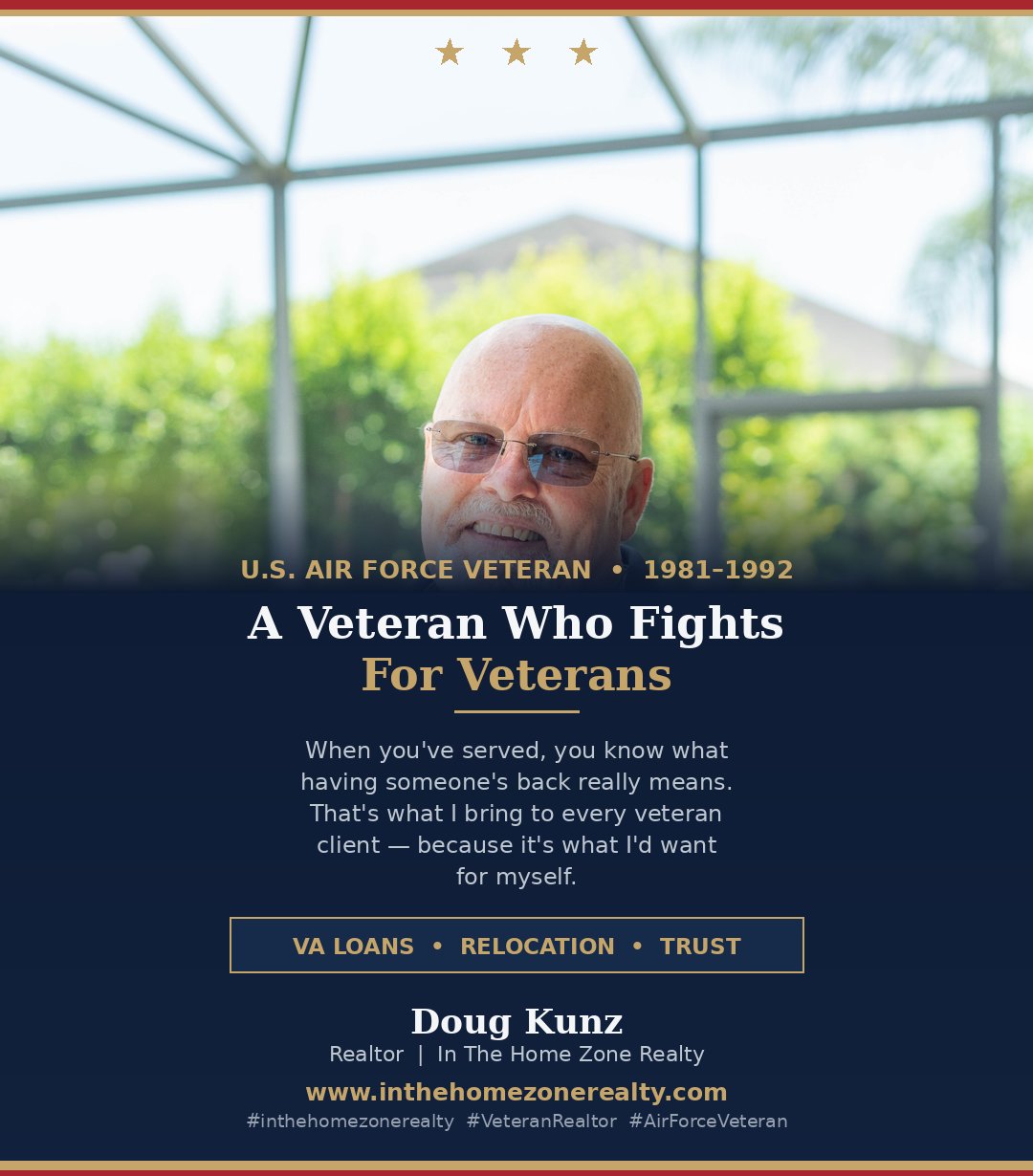
The Complete VA Loan FAQ for Veteran Homebuyers
Military Relocation Douglas Kunz August 31, 2026
Military Relocation Douglas Kunz August 31, 2026
Answers from Doug Kunz, Realtor & U.S. Air Force Veteran (1981–1992)
Your VA loan benefit is one of the most powerful tools available to you as a veteran — but it's also one of the most misunderstood. Below is an in-depth breakdown of how it actually works, organized by topic so you can jump to what matters most to you.
Generally, you qualify if you meet one of these service requirements:
Your Certificate of Eligibility (COE) is the official document confirming your status, and it also shows your entitlement amount — more on that below.
Entitlement is the dollar amount the VA guarantees to your lender if you default — think of it as the VA's way of backing your loan so lenders can offer $0-down financing. There are two layers:
For 2026, the standard baseline conforming loan limit is $832,750 in most counties (higher in designated high-cost areas). That means most veterans with full entitlement have access to roughly $208,000 in combined guaranty — which is why there's effectively no cap on how much home you can buy with $0 down, as long as your lender approves you for it.
Yes — this is one of the most misunderstood parts of the benefit. Your entitlement isn't a one-time voucher; it's more like a reusable credit line. When you sell a home and pay off the VA loan, your entitlement is restored and you can use it again. You can also use partial remaining entitlement to buy a second home without selling the first, which leads to the next question.
In many cases, yes — this is common for active-duty members with PCS orders who want to keep their current home (often as a rental) while buying at their new duty station. This uses what's called second-tier entitlement: your remaining guaranty (after subtracting what's tied up in your current loan) determines how much you can borrow with $0 down on the second home. If the new loan exceeds your remaining zero-down threshold, a partial down payment may be required on the difference. Your lender calculates this precisely from your COE — I always recommend getting this confirmed early if you're planning a PCS-related purchase.
Your lender can typically pull this for you instantly through the VA's automated system. You can also request it yourself through the VA.gov portal, or by mail with your discharge paperwork (DD-214). I can point you in the right direction when we start working together.
The funding fee is a one-time payment to the VA that helps sustain the loan program — it's what allows the VA to keep offering $0-down loans without charging monthly mortgage insurance.
Current purchase loan rates:
Down Payment | First-Time Use | Subsequent Use |
|---|---|---|
Less than 5% down | 2.15% | 3.30% |
5%–9.99% down | 1.50% | 1.50% |
10% or more down | 1.25% | 1.25% |
You can pay it upfront at closing or roll it into your loan balance (which increases your loan amount and total interest paid over time).
You likely qualify for a full exemption if you:
If you're later awarded a disability rating retroactively, you may also be eligible for a refund of a funding fee you already paid — this is something many veterans don't realize and miss out on.
Yes. Moving from 0% down to 5% down drops your funding fee significantly (for example, from 2.15% to 1.50% on a first-time use loan). It's worth running the numbers with your lender to see if a modest down payment makes sense for your situation — sometimes it does, sometimes keeping your cash in reserve is the smarter move.
VA loans limit which closing costs you can be charged, but you'll still typically see:
All-in, most veterans see total costs (including the funding fee) land somewhere in the 2%–5% range of the loan amount, depending on your specific fees and whether the funding fee is financed or paid upfront.
Yes — VA guidelines allow sellers to contribute up to 4% of the purchase price toward your "concessions" (which can include your funding fee), plus your standard closing costs outside of that cap. This is a powerful negotiating tool, especially in a buyer's market, and something I factor into how we structure your offer.
VA loans are for primary residences only — you can't use one to buy a straight investment property or vacation home.
The VA appraisal is a required step that does two things: confirms the home is worth what you're paying, and verifies it meets the VA's Minimum Property Requirements (MPRs) — baseline standards covering things like a functioning roof, heating system, safe water supply, and no exposed hazards.
Important: the appraisal is not the same as a home inspection. I always recommend a full independent inspection too, since the appraisal is focused on value and minimum safety standards, not a full mechanical and structural evaluation.
If the appraiser flags issues, they typically need to be repaired before closing. Sometimes this becomes a negotiation point with the seller — VA guidelines actually prohibit the buyer from paying for certain required repairs, which can work in your favor.
It depends on your market. Not every condo project is VA-approved, but many are, and if a project isn't currently approved, in some cases we can pursue a spot approval. This is something I check early when a condo is on your list, so it doesn't derail your timeline later.
You can use any VA-approved lender — most major banks and mortgage companies are approved to originate VA loans. What matters more is finding a loan officer who is genuinely experienced with VA loans specifically, since the underwriting nuances (COE, entitlement calculations, MPRs) trip up lenders who don't handle them often. I work with several VA-savvy lenders I can introduce you to.
The VA doesn't set a minimum score — individual lenders do, and most look for something in the 580–620+ range, though this varies. VA loans are generally more forgiving than conventional loans on credit history, which is part of why they're such a strong benefit.
Rather than relying solely on debt-to-income ratio like conventional loans often do, VA underwriting also looks at residual income — the money you have left over each month after your major expenses. This is designed to make sure you can comfortably afford your life, not just your mortgage payment, and it's actually one reason VA loans have historically had strong repayment performance.
Usually 30–45 days, similar to conventional loans, assuming your COE and documentation are in order and your lender is experienced with VA loans. Delays usually come from unfamiliar lenders, not the VA loan type itself.
It's illegal for a seller to refuse a VA offer because it's VA financing, but some sellers still hold onto outdated myths about VA loans being slow or difficult. Part of my job is presenting your offer in a way that puts those concerns to rest — strong pre-approval documentation, a responsive lender, and a clear closing timeline go a long way.
An Interest Rate Reduction Refinance Loan (IRRRL), sometimes called a "VA Streamline Refinance," lets you refinance an existing VA loan into a lower rate with minimal paperwork — often no new appraisal or income verification required. The funding fee for an IRRRL is a flat 0.50%, much lower than a purchase loan.
Yes, and uniquely, VA cash-out refinances are available even if your current mortgage isn't a VA loan — you can refinance a conventional or FHA loan into a VA loan and pull cash out, assuming you qualify. Note that cash-out refinances are charged the same funding fee rate as a purchase with $0 down (2.15% first use, 3.30% subsequent), regardless of your actual equity.
Yes — VA loans are assumable, meaning a qualified buyer (veteran or not, depending on lender approval) can take over your existing loan terms, including your interest rate. This can be a major selling point if you have a lower rate than the current market. The assumption funding fee is just 0.5% of the remaining loan balance. Note: if a non-veteran assumes your loan without you formally releasing liability, it can tie up your entitlement — this is worth discussing carefully before agreeing to it.
You may still have usable entitlement remaining, but it depends on your specific circumstances and how the previous loan was resolved. This is a conversation I have directly with veterans in this situation — it's not disqualifying by default, but it needs a clear-eyed look at your COE and lender guidelines.
Yes, and adding a spouse as co-borrower doesn't affect your entitlement usage. Non-spouse co-borrowers are also possible in certain situations, though it may change your down payment requirements — worth a direct conversation with your lender if this applies to you.
I'm Doug Kunz — U.S. Air Force veteran (1981–1992) and Realtor. I know what your service means because I've lived it, and I'm here to make sure you have an agent who genuinely has your best interests at heart, from your first search to closing day.
📞 Contact me to get started 🌐 www.inthehomezonerealty.com
This FAQ is for general informational purposes only and does not constitute legal, financial, or lending advice. VA loan terms, rates, limits, and eligibility requirements change periodically — always confirm current details directly with the VA and your chosen lender before making financial decisions.
Military Relocation
Douglas Kunz | August 31, 2026
Everything veterans need to know about entitlement, funding fees, and the home-buying process — explained by a fellow service member.

August 27, 2026
August 20, 2026
August 13, 2026
August 13, 2026
August 13, 2026

About Us/Meet the team
August 7, 2026
Why real estate doesn't run 9-to-5, and neither do I.

August 6, 2026
August 6, 2026
Our team brings deep Titusville expertise, honest guidance, and a genuine investment in every client outcome. We are not just here to close deals — we are here to help you make one of the biggest decisions of your life with confidence.

In The Home Zone Realty | Douglas Kunz Team
2323 S Washington Ave Ste 211 Titusville, FL 32780